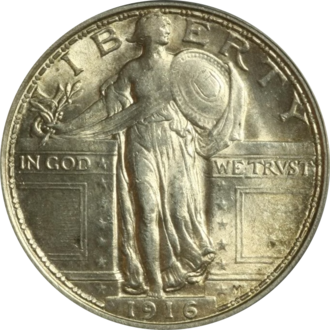
1923-S Standing Liberty Quarter
Semi-keyOne of the keys of the series. San Francisco struck fewer than 1.4 million and they circulated, so it is scarce in every grade.
Mintage
- Business strikes
- 1,360,000
- Mint
- San Francisco (S)
- Mintage rank
- 5 of 37
Rank 1 is the lowest business-strike mintage in the series. Mintage is what the Mint produced, not what survives. These circulated through the 1920s and 1930s and were melted for their silver later, none of it recorded by date. On the 1916-1924 issues the date itself wore away, so a large share of what survives cannot be attributed to a year at all.
Reading the figure
Among the 12 San Francisco issues in the series it is the 2nd smallest. Of the 11,076,000 struck across all mints in 1923, this issue accounts for 12%. Philadelphia struck 7.1 times as many that year. The 1923 split ran Philadelphia 9,716,000 and San Francisco 1,360,000. The series median is 3,586,400, so fewer than half as many of these were struck as a typical date. Series-wide output rose sharply that year: 11,076,000 against 1,916,000 in 1921. In 1923 the coin was struck at Philadelphia and San Francisco; Denver struck none.
Every sentence above is computed from the mintage table on this page, not asserted separately.
Scarcity tier
Semi-key
Assigned from reported mintage alone: under 750,000 is a key date, under 2,500,000 is a semi-key.
This is a reproducible label derived from the mintage column, not a market valuation and not a Coin Curator price opinion. The same thresholds apply to every series on this site. Several dates are far harder or far easier to obtain than their mintage implies; where that is true, it is stated above.
Recent sold prices
Last checked Sep 16, 2026 · most recent sale Aug 29, 2026What certified 1923-S Standing Liberty quarters actually sold for on eBay in the last 90 days, grouped by grade band. Every figure below is a completed sale of a PCGS, NGC or ANACS coin in a straight grade. This is a record of what changed hands, not a price guide, an appraisal, or a prediction of what yours is worth.
Good to Fine
PO1 to F15$575
Median of 5 sales
- Lowest
- $470
- Highest
- $757
The 4 most recent sales
- $503PCGS G6 · Aug 29, 20261923-S Standing Liberty Quarter PCGS Good-6 key date
- $470PCGS G6 · Aug 2, 2026Certified 1923-S Standing Liberty Quarter PCGS G06 SLQ 25c Coin
- $757ANACS F12 · Jul 30, 20261923-S 25C STANDING LIBERTY SILVER QUARTER KM# 145 ANACS F 12 A7832
- $652PCGS G6 · Jul 23, 20261923 S Standing Liberty Silver Quarter Dollar PCGS G 6
Seller titles, verbatim. An ended eBay listing stays readable for about 90 days, so older links will expire.
Very Fine to XF
VF20 to XF45$1,082
Median of 4 sales
- Lowest
- $900
- Highest
- $1,400
The 4 most recent sales
- $903PCGS VF20 · Aug 10, 2026PCGS VF20 1923 S STANDING LIBERTY QUARTER KEY DATE VERY NICE COLOR
- $900ANACS VF25 · Aug 8, 20261923 S Standing Liberty Silver Quarter 25C Old Soapbox Holder ANACS VF 25
- $1,400PCGS VF35 · Aug 5, 20261923 S 25c Standing Liberty Silver Quarter San Francisco PCGS VF35
- $1,260NGC VF35 · Jun 25, 20261923 S Standing Liberty Quarter VF 35 NGC Silver 25c Coin SKU:I20583
Seller titles, verbatim. An ended eBay listing stays readable for about 90 days, so older links will expire.
How to read these
- The median is the middle sale after removing outliers. The range is every sale kept, including the outliers, so you can see how wide the market actually is.
- Grade drives most of the difference. A band with three sales tells you far less than a band with thirty, and the count is shown so you can weigh it.
- Sales of coins in “Details”, “Genuine” or cleaned holders are excluded, as are proofs, replicas, lots, and mounted coins. Those sell at prices that would not describe the coin on this page.
- So is any sale priced below what this same date fetches in a lower grade, which is impossible for a real coin and is how a counterfeit in a convincing holder gives itself away.
- 3 further qualifying sales fell in a grade band with fewer than 3 sales, which is too few to report a median from, so they are not shown.
Coin Curator does not grade, authenticate, or appraise coins, and holds no licensed price guide or population data. How this data is collected.
The date wears off the early issues. On the 1916-1924 quarters the date sits raised on a pedestal at the base of the obverse, exposed to every hand that touched the coin. Read the full note on the series page.
What to check before buying
Specific to the 1923-S:
- 1Confirm the date is genuinely struck and legible rather than restored with acid, which leaves a dull pitted patch around the digits. The grading services will not certify an acid-treated coin.
And for any certified coin
Verify the certification number on the grading service’s own lookup rather than from a photograph of the label, match the listing images to the certification record including grade and any variety attribution, look for cleaning, compare the mintmark against published photographs of the genuine issue, and read the return policy before buying. The grading guide covers each of these in full.
Coin Curator does not grade, authenticate, or appraise coins, and holds no licensed price guide or population data. Where this page shows recent sold prices, they are records of completed eBay sales, not a valuation of any particular coin. These are verification steps, not an appraisal.
Verify a certification number
Look a 1923-S certification number up on the service’s own site. A photograph of a label proves nothing.
Each service publishes its own guarantee with conditions and exclusions. Compare PCGS, NGC and ANACS.
Find a 1923-S for sale
Opens an eBay search for this exact date and mint. Coin Curator does not list inventory, hold stock, or set prices; verify each listing, seller, and return policy directly.
Affiliate link: Coin Curator may earn a commission at no extra cost to you. Disclosure.
Common questions
How many 1923-S Standing Liberty quarters were minted?
The San Francisco Mint struck 1,360,000 1923-S Standing Liberty quarters for circulation. That is the 5th lowest business-strike mintage of the 37 date and mintmark combinations in the series.
Is the 1923-S Standing Liberty quarter a key date?
Coin Curator labels it a semi-key, assigned from reported mintage alone: under 750,000 struck is a key date and under 2,500,000 is a semi-key. The same thresholds are used for every series on this site, so the tiers are comparable between them. That label describes production, not market value or how hard the coin is to find today. One of the keys of the series. San Francisco struck fewer than 1.4 million and they circulated, so it is scarce in every grade.
What should I check before buying a 1923-S Standing Liberty quarter?
Verify the certification number on the grading service's own lookup page, match the listing photographs to the certification record, check for cleaning, and compare the mintmark shape and position against published photographs of the genuine issue. Confirm the date is genuinely struck and legible rather than restored with acid, which leaves a dull pitted patch around the digits. The grading services will not certify an acid-treated coin.
Related dates
Guides for this coin
All guides →Building a US Type Set
Build a U.S. type set by defining the included designs, grade targets, verification rules, and a current coin-by-coin budget.
2 min readMarket ContextJunk Silver vs Graded Silver: How to Think About the Tradeoffs
Pre-1965 US silver coins (junk silver) and certified examples of the same coins respond to different inputs. A framework for researching each one: what to verify, what melt value does and does not cover, and when each is worth a closer look.
1 min readBuying GuideHow to Spot a Counterfeit or Doctored Coin
Use weight, dimensions, surfaces, mintmark details, holder inspection, and certification records as screening checks. Learn the warning signs of altered coins and fake slabs.
1 min readBuying GuideMS-63 vs MS-65 vs MS-67: Which Grade to Actually Buy
Adjacent grades can carry very different market evidence. Learn how to compare surfaces, eye appeal, population data, and current records before choosing a grade.
1 min readMintage sources
Mintage figures are U.S. Mint production records, cross-checked against the published tables below on 2026-08-01. Where those tables disagree, the disagreement is disclosed on the affected page rather than resolved silently.
- CoinMintages.com, Standing Liberty quarter mintages — Reports the 1917 Variety 1 and Variety 2 issues separately for each mint.
- LandOfCoins, Standing Liberty quarter mintage — Independent table. Agrees with the above on every one of the 37 issues.
Spotted an error? Submit a correction.