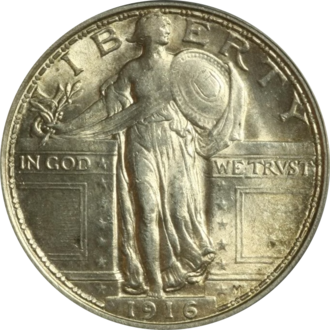
Standing Liberty Quarter Dates & Mintmarks
All 37 issues of the series, 1916 through 1930, designed by Hermon A. MacNeil. Six of them come from 1917 alone, because the design was revised partway through the year and both types were struck at all three mints with separately reported mintages. No quarters at all were struck in 1922.
No price guide, valuation or population count appears anywhere in this catalog: Coin Curator holds no licensed data for any of those. Key and semi-key date pages additionally carry recent eBay sold prices, which are records of completed sales rather than a valuation. How we work.
37
Date/mint combinations
2
Key dates
under 750k struck
12
Semi-keys
under 2.5M struck
3
Mints
P, D, S
| Date | Mint | Mintage | Rank | Tier | Notes |
|---|---|---|---|---|---|
| 1916-P | Philadelphia | 52,000 | 1 | Key date | — |
| 1917-D Type 1 | Denver | 1,509,200 | 6 | Semi-key | — |
| 1917-D Type 2 | Denver | 6,224,400 | 22 | Common date | — |
| 1917-P Type 1 | Philadelphia | 8,740,000 | 26 | Common date | 1 documented variety |
| 1917-P Type 2 | Philadelphia | 13,880,000 | 35 | Common date | 1 documented variety |
| 1917-S Type 1 | San Francisco | 1,952,000 | 14 | Semi-key | — |
| 1917-S Type 2 | San Francisco | 5,552,000 | 20 | Common date | — |
| 1918-D | Denver | 7,380,800 | 25 | Common date | — |
| 1918-P | Philadelphia | 14,240,000 | 36 | Common date | — |
| 1918-S | San Francisco | 11,072,000 | 29 | Common date | 1 documented variety · see note |
| 1919-D | Denver | 1,944,000 | 13 | Semi-key | — |
| 1919-P | Philadelphia | 11,324,000 | 32 | Common date | — |
| 1919-S | San Francisco | 1,836,000 | 11 | Semi-key | — |
| 1920-D | Denver | 3,586,400 | 19 | Common date | — |
| 1920-P | Philadelphia | 27,860,000 | 37 | Common date | — |
| 1920-S | San Francisco | 6,380,000 | 24 | Common date | — |
| 1921-P | Philadelphia | 1,916,000 | 12 | Semi-key | — |
| 1923-P | Philadelphia | 9,716,000 | 27 | Common date | — |
| 1923-S | San Francisco | 1,360,000 | 5 | Semi-key | — |
| 1924-D | Denver | 3,112,000 | 18 | Common date | — |
| 1924-P | Philadelphia | 10,920,000 | 28 | Common date | — |
| 1924-S | San Francisco | 2,860,000 | 17 | Common date | — |
| 1925-P | Philadelphia | 12,280,000 | 34 | Common date | — |
| 1926-D | Denver | 1,716,000 | 9 | Semi-key | — |
| 1926-P | Philadelphia | 11,316,000 | 31 | Common date | — |
| 1926-S | San Francisco | 2,700,000 | 16 | Common date | — |
| 1927-D | Denver | 976,000 | 3 | Semi-key | — |
| 1927-P | Philadelphia | 11,912,000 | 33 | Common date | — |
| 1927-S | San Francisco | 396,000 | 2 | Key date | — |
| 1928-D | Denver | 1,627,600 | 8 | Semi-key | — |
| 1928-P | Philadelphia | 6,336,000 | 23 | Common date | — |
| 1928-S | San Francisco | 2,644,000 | 15 | Common date | — |
| 1929-D | Denver | 1,358,000 | 4 | Semi-key | — |
| 1929-P | Philadelphia | 11,140,000 | 30 | Common date | — |
| 1929-S | San Francisco | 1,764,000 | 10 | Semi-key | — |
| 1930-P | Philadelphia | 5,632,000 | 21 | Common date | — |
| 1930-S | San Francisco | 1,556,000 | 7 | Semi-key | — |
Rank 1 is the lowest business-strike mintage in the series. Tiers are assigned from reported mintage alone: under 750,000 struck is a key date, under 2,500,000 a semi-key. The same thresholds apply to every series on this site, so tiers are comparable between them. That is a production measure, not a market judgement, and not a statement about how many survive.
Shopping the series
Individual date pages open a search for that exact date and mint. This one covers the series. Verify every listing, seller, and return policy directly.
Affiliate link: Coin Curator may earn a commission at no extra cost to you. Disclosure.
Common questions
How many Standing Liberty quarter dates and mintmarks are there?
37: 15 from Philadelphia, 10 from Denver and 12 from San Francisco. Six come from 1917, where the Type 1 and Type 2 coins of each mint are separately reported. No quarters were struck anywhere in 1922, and in 1916, 1921 and 1925 only Philadelphia struck them.
Which Standing Liberty quarter has the lowest mintage?
The 1916 at 52,000, one of the lowest mintages of any twentieth-century U.S. coin. MacNeil's design was approved so late in the year that only a token quantity was struck before 1916 ended. The 1927-S at 396,000 is next, and is the harder of the two to find in high grade because it circulated where the 1916 was recognised as scarce early.
What is the difference between the Type 1 and Type 2 quarters?
Type 1, struck in 1916 and the early part of 1917, shows Liberty with the breast exposed and the reverse eagle set lower with three stars beneath it. Type 2, from mid-1917 onward, adds a coat of chain mail and raises the eagle with the stars rearranged below. The change is popularly attributed to objection over the exposed breast, though numismatic scholarship has long questioned that account and points to MacNeil's own wish to revise the design.
Why do so many Standing Liberty quarters have no date?
On the 1916-1924 quarters the date sits raised on a pedestal at the base of the obverse, exposed to every hand that touched the coin. It wears away before any other detail, which is why dateless Standing Liberty quarters turn up in quantity and why circulated coins from those years are so often unattributable. The Mint recessed the date in 1925 and the problem disappears from then on. Two consequences for buyers: a readable date on a heavily worn early coin is worth confirming rather than assuming, and acid-restored dates, which leave a dull pitted patch around the digits, are widespread. Grading services will not certify an acid-treated coin, so on the scarce early dates the certification record is doing real work.
What does Full Head mean on a Standing Liberty quarter?
Liberty's head is the last part of the obverse to strike up, and when the three leaves in her hair, the hairline across her brow and the ear opening are all complete, the grading services add a Full Head designation. It is a strike designation, not a grade: a Full Head coin can grade lower than one without. It matters because on several dates, notably the 1926-D and the branch-mint issues of 1919 and 1920, the head almost never came up fully, so the designation rather than the mintage is what separates an ordinary example from a difficult one.
What is the 1918/7-S, and why does it not have its own entry?
It is an overdate, struck from a 1918 die punched over a 1917 one, with the 7 visible beneath the 8. It is one of the most valuable coins of the series. The Mint never reported it separately, because it was not a separate issue, so its coins sit inside the 1918-S total and it is documented here as a variety of that issue. An entry exists in this catalog only where the production record gives one.
Does Coin Curator publish Standing Liberty quarter values?
Not as a valuation. Key and semi-key date pages carry recent eBay sold prices: what certified examples actually sold for in the last 90 days, grouped by grade band, with the number of sales and the full range shown alongside each median. That is a record of completed sales, not a price guide, an appraisal, or a population and census count, none of which Coin Curator holds licensed data for. Common dates carry no sold data at all. Pages link to the grading services' own certification lookups and to marketplace searches so you can check current evidence yourself.
Mintage sources
Mintage figures are U.S. Mint production records, cross-checked against the published tables below on 2026-08-01. Where those tables disagree, the disagreement is disclosed on the affected page rather than resolved silently.
- CoinMintages.com, Standing Liberty quarter mintages — Reports the 1917 Variety 1 and Variety 2 issues separately for each mint.
- LandOfCoins, Standing Liberty quarter mintage — Independent table. Agrees with the above on every one of the 37 issues.
Spotted an error? Submit a correction.